Brand teams hear customer questions in several places: social comments, chats, sales conversations and product pages. A repeated question can be a useful signal, but it is not proof that every buyer shares the concern. Capture the context, verify what can be answered and turn the topic into a brief the team can execute.
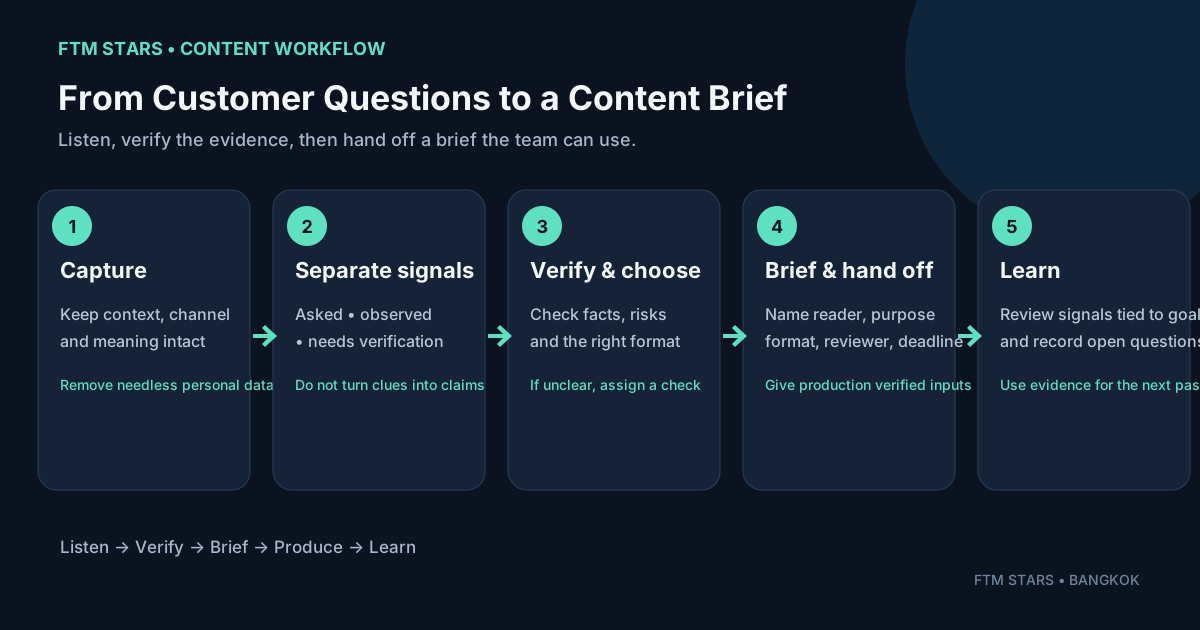
1. Capture the question without losing its meaning
Record the original wording or a faithful summary, plus the date, channel, product context and situation. Remove personal information the team does not need. Do not edit a question until its meaning changes, and do not publish a customer’s words as a testimonial without appropriate permission.
2. Separate observations from conclusions
Group questions into themes such as usage, suitability, differences, delivery or purchase concerns. Keep these three things distinct:
- What the customer asked: the original wording or a faithful summary
- What the team observed: context or patterns in the examples actually reviewed
- What still needs verification: information to confirm with the product owner or customer-service team
One example is a clue, not evidence that everyone thinks the same way.
3. Prioritize with checks the team can explain
Before choosing a topic, ask:
- Does the question affect a real decision or use case?
- Does the team have approved information to answer it?
- Which format fits: an article, demonstration video, explanatory visual or FAQ?
- Is there a relevant page or next step that genuinely helps the reader?
- Are there claim, privacy or asset-rights issues to review?
If the answer is not verified, assign a fact-check to the product owner or customer-service team rather than filling the gap with a guess.
4. Copy this brief template
- Topic or question: State the reader’s question plainly.
- Reader: Who is deciding or trying to do what?
- Source signal: Channel, dates and the sample the team actually reviewed.
- Purpose: What should the reader understand or be able to do?
- Verified facts: Name the internal owner and supporting source.
- Do not infer: Claims or comparisons that lack evidence.
- Format and channel: Article, video, visual or page content, with file requirements.
- Review: Fact-checker, brand approver and feedback deadline.
- Next step: A relevant existing page or contact route.
5. Hand off to creative and production
Once the brief is confirmed, provide anonymized examples, approved facts, voice guidance and channel constraints. For photo or video production, specify shots that answer the question rather than simply asking for something “engaging.” Name one feedback coordinator and set clear review checkpoints so production receives consolidated, actionable notes.
6. Close the loop after publishing
Review signals that match the content’s purpose, such as continued reading, clicks to a product page, follow-up questions or form submissions. Do not treat one metric as proof of total business impact. Record which question has been answered, what remains open and what the next iteration should test.
A simple tracking sheet
Create one row per question or topic, using fields such as:
- Date and channel
- Question summary and theme
- Number of examples reviewed
- Fact to verify and verification owner
- Content format and brief status
- Post-publication learning
This workflow connects customer insight to a focused Content Sprint and production plan, while keeping fact-checking and publication approval with accountable people.